
Why 304L Matters: Understanding UNS S30403 Blind Flanges?
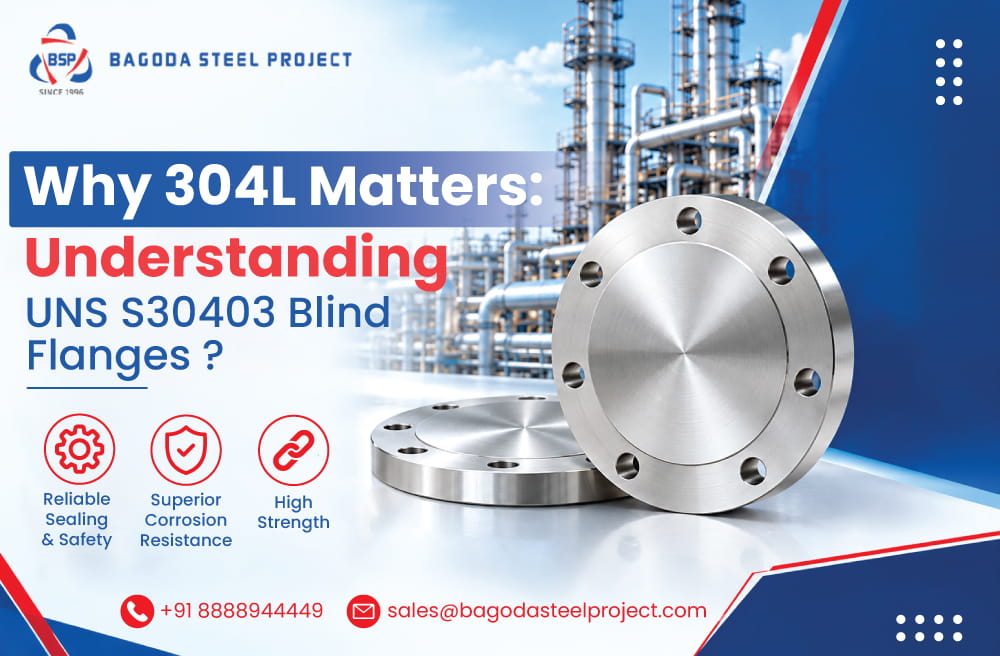
Why 304L Matters: Understanding UNS S30403 Blind Flanges?
In industrial engineering, choosing the right material is rarely just about selecting a metal that fits a design. It is about understanding how that material performs under pressure, temperature changes, exposure to corrosive substances, and years of continuous operation. Even a small difference in chemical composition can influence the durability, reliability, and maintenance requirements of an entire piping system.
This is where UNS S30403, commonly known as 304L stainless steel, becomes important.
At Bagoda Steel Project, we understand that industrial buyers, project engineers, and procurement professionals need materials that balance performance, fabrication requirements, and long-term value. Whether the application involves chemical processing, water treatment, food production, or industrial piping, understanding 304L stainless steel helps professionals make informed decisions.
But what makes UNS S30403 different, and why is it relevant when selecting components such as UNS S30403 Blind Flanges?
Let's explore.
What Is UNS S30403?
UNS S30403 is the Unified Numbering System designation for 304L stainless steel, a low-carbon austenitic stainless steel grade. It belongs to the widely used 300 series of stainless steels and is valued for its corrosion resistance, weldability, and versatility.
The letter “L” in 304L stands for low carbon. Compared with standard 304 stainless steel, 304L has a lower maximum carbon content, which helps reduce the risk of sensitisation during welding.
Sensitisation occurs when chromium carbides form along grain boundaries under certain thermal conditions, potentially reducing corrosion resistance in affected areas. The lower carbon content of 304L helps minimise this risk, making it particularly useful for welded fabrications.
Typical characteristics include:
- Carbon content: Maximum 0.03%.
- Chromium content: Approximately 18–20%.
- Nickel content: Approximately 8–12%.
- Structure: Austenitic stainless steel.
- Key properties: Good corrosion resistance, formability, and weldability.
Exact chemical composition and mechanical requirements should always be verified against the applicable material standard and product certification.
Why Does 304L Matter in Industrial Applications?
-
Improved Weldability and Reduced Sensitisation Risk
Welding is an essential part of industrial fabrication. Pipelines, tanks, process equipment, and structural assemblies frequently require multiple welded joints.
The lower carbon content of UNS S30403 helps reduce carbide precipitation during welding, particularly in applications where post-weld heat treatment is not practical. This makes 304L a useful choice for fabricated equipment and welded piping systems.
For engineers, this can simplify material selection and help maintain corrosion resistance in welded components. However, appropriate welding procedures and service-specific assessments remain necessary.
-
Reliable Corrosion Resistance
Corrosion can lead to leakage, unplanned shutdowns, product contamination, and costly repairs. Selecting a suitable stainless steel grade is therefore an important part of protecting industrial infrastructure.
UNS S30403 offers good resistance to many atmospheric conditions, water-based environments, and a range of mildly corrosive process media.
It is commonly considered for food-processing equipment, beverage production, pharmaceutical facilities, water-handling systems, and general chemical-processing applications.
However, 304L is not suitable for every corrosive environment. Chloride-rich solutions, seawater, and certain aggressive chemicals may require more resistant alloys, depending on concentration, temperature, and operating conditions.
-
Versatility Across Different Industries
One reason 304L stainless steel remains widely used is its adaptability.
Manufacturers and industrial operators may use it in:
- Food and beverage processing equipment.
- Pharmaceutical and hygienic process systems.
- Chemical-processing installations.
- Water treatment and distribution equipment.
- Storage tanks and fabricated vessels.
- General industrial piping and fluid-handling systems.
Its combination of corrosion resistance, fabrication flexibility, and availability makes it a practical option for many applications where extreme corrosion resistance is not required.
Understanding UNS S30403 Blind Flanges
A blind flange is a solid, disc-shaped piping component used to close the end of a pipe, seal a nozzle, or isolate a section of a piping system. Unlike conventional flanges, it does not have a central bore for fluid passage.
UNS S30403 Blind Flanges are blind flanges manufactured from 304L stainless steel. They combine the functional purpose of a pressure-containing closure with the material's useful corrosion-resistant and fabrication properties.
These flanges may be considered for applications such as:
- Closing unused pipeline connections.
- Isolating equipment during maintenance.
- Sealing vessel openings and process-system nozzles.
- Providing access points for future system expansion.
- Supporting suitable low- to moderate-corrosion industrial services.
The correct flange must be selected according to the required pressure class, dimensions, facing, applicable standards, temperature, and process-fluid compatibility. The suitability of 304L should be confirmed for the actual operating conditions.
For procurement teams, specifying the grade alone is not enough. Material traceability, dimensional conformity, pressure-rating requirements, and inspection documentation are equally important.
304L vs 304 Stainless Steel: What Is the Difference?
Although 304 and 304L have similar chemical compositions and many comparable properties, their carbon limits differ.
Standard 304 stainless steel generally permits a maximum carbon content of 0.08%, while 304L limits carbon to 0.03%.
This difference makes 304L particularly useful for welded components because it reduces the risk of sensitisation. In many applications, their mechanical properties and corrosion performance overlap, but actual requirements depend on product form, applicable standards, and service conditions.
For buyers sourcing UNS S30403 Blind Flanges, 304L may be a sensible choice when welding-related corrosion concerns influence the specification. Nevertheless, the final selection should be based on engineering requirements rather than grade names alone.
How to Select the Right UNS S30403 Blind Flanges
Choosing the right flange requires more than comparing quotations. A systematic evaluation helps prevent specification errors and unnecessary replacement costs.
First, confirm the material grade. Ensure that the product documentation identifies UNS S30403 or the applicable 304L designation.
Second, verify the standard and pressure class. Confirm the required flange dimensions, rating, facing, and applicable manufacturing standard, such as ASME B16.5 where relevant.
Third, assess operating conditions. Consider process-fluid composition, chlorides, temperature, pressure, and cleaning chemicals.
Fourth, review quality documentation. Request material test certificates, heat-number traceability, and any inspection reports required by the project.
Finally, evaluate the supplier. A dependable supplier should understand the application, clarify technical requirements, and provide products that meet the specified standards.
At Bagoda Steel Project, this practical approach reflects an important principle: the right industrial component is one that meets the engineering requirement, not simply the lowest quoted price.
Why Choose Bagoda Steel Project?
Industrial projects depend on consistency, communication, and accurate specifications. Buyers need a sourcing partner who recognises that even a seemingly simple component, such as a blind flange, plays a role in the reliability of the complete piping system.
Bagoda Steel Project focuses on helping industrial buyers understand material requirements and identify suitable steel products for their applications. When evaluating UNS S30403 Blind Flanges, customers should prioritise grade verification, dimensional accuracy, traceability, and compliance with the applicable project standards.
A well-informed purchasing decision can support smoother fabrication, dependable installation, and more predictable maintenance planning.
Conclusion: Small Material Differences, Significant Industrial Value
UNS S30403 demonstrates why understanding material specifications matters. Its low carbon content, good weldability, and corrosion resistance make 304L stainless steel a valuable option for many fabricated products and piping applications.
For industrial buyers considering UNS S30403 Blind Flanges, the key is to match the material and flange specification to the actual service environment. Pressure requirements, chemical exposure, temperature, fabrication methods, and quality documentation must all be considered.
At Bagoda Steel Project, informed material selection begins with understanding the application. When engineers and procurement teams look beyond the product name and examine its properties, they can make decisions that better support industrial performance, safety, and long-term value.
Frequently Asked Questions (FAQs)
1. What is UNS S30403 stainless steel?
UNS S30403 is the Unified Numbering System designation for 304L stainless steel, a low-carbon austenitic stainless steel known for good corrosion resistance, weldability, and fabrication versatility.
2. What are UNS S30403 Blind Flanges used for?
UNS S30403 Blind Flanges are used to seal pipe ends, close unused connections, isolate sections of piping, and seal suitable vessel or equipment openings. Their suitability depends on the application's pressure, temperature, and corrosion requirements.
3. What is the difference between 304 and 304L stainless steel?
The principal difference is carbon content. Grade 304 generally allows up to 0.08% carbon, whereas 304L allows a maximum of 0.03%. The lower carbon content of 304L helps reduce sensitisation risk during welding.
4. Are UNS S30403 Blind Flanges suitable for chemical industries?
They can be suitable for certain chemical-processing applications where 304L provides adequate corrosion resistance. Compatibility depends on the chemical involved, its concentration, operating temperature, and other service conditions. More resistant alloys may be needed for aggressive environments.
5. How can buyers select a reliable UNS S30403 Blind Flanges supplier?
Buyers should verify the material grade, applicable flange standard, pressure class, dimensions, material test certificates, traceability, and inspection requirements. They should also confirm that the supplier can meet the project's technical and delivery requirements.
