
What Are UNS S30403 Blind Flanges and Where Are They Commonly Used in Piping Systems?
What Are UNS S30403 Blind Flanges and Where Are They Commonly Used in Piping Systems?
In modern piping systems, selecting the right flange material is essential for ensuring leak-free connections, corrosion resistance, mechanical reliability, and long service life. Among the many stainless steel grades used for industrial piping, UNS S30403 Blind Flanges are widely preferred for applications that require excellent corrosion resistance, good weldability, and dependable performance.
UNS S30403 is the Unified Numbering System designation for 304L stainless steel, a low-carbon version of the popular 304 stainless steel grade. When manufactured as blind flanges, this material provides an effective way to temporarily or permanently close the end of a pipe, nozzle, valve, or pressure vessel connection. SS 304L blind flanges are therefore commonly found in industries such as chemical processing, food and beverage, pharmaceuticals, petrochemicals, water treatment, and general engineering.
What Are UNS S30403 Blind Flanges?
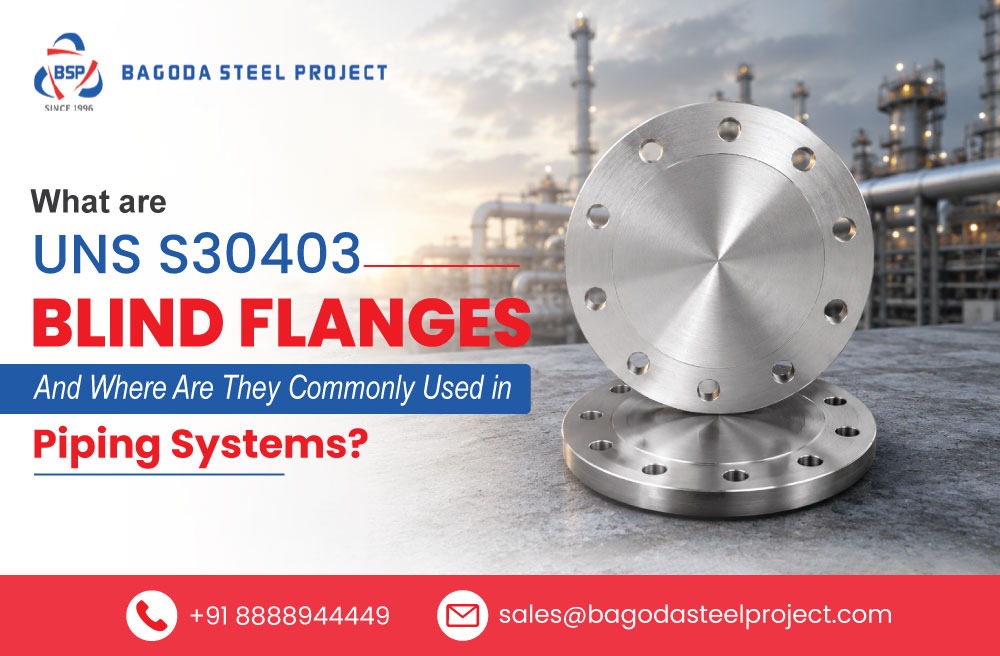
A blind flange is a solid, disc-shaped flange without a central bore. Unlike weld neck, slip-on, or socket weld flanges, a blind flange is designed specifically to block the flow through a piping system.
UNS S30403 Blind Flanges are manufactured from 304L stainless steel and are bolted onto another flanged component using a gasket and suitable fasteners. Their primary purpose is to provide a secure closure while also allowing convenient access for future inspection, cleaning, maintenance, or system modification.
The low carbon content of UNS S30403 makes these flanges particularly suitable for welded piping systems. Reduced carbon content minimizes the risk of chromium carbide precipitation during welding, helping improve resistance to intergranular corrosion.
Key Characteristics of SS 304L Blind Flanges
One of the biggest advantages of SS 304L blind flanges is their combination of corrosion resistance and fabrication properties. They can perform reliably in many mildly to moderately corrosive environments.
Important characteristics include:
- Excellent general corrosion resistance
- Low carbon content for improved weldability
- Good resistance to oxidation
- Strong mechanical performance
- Excellent formability and machinability
- Hygienic and easy-to-clean surface
- Suitable for a wide range of temperatures
- Long service life with appropriate application selection
UNS S30403 also offers good resistance to atmospheric corrosion and many organic and inorganic chemicals. However, it is important to select another stainless steel or nickel alloy when the application involves highly aggressive chemicals, high chloride concentrations, or severe operating conditions.
How Do Blind Flanges Work in Piping Systems?
The fundamental purpose of a blind flange is to stop the flow of fluid through a particular section of piping. The flange is installed at the end of a pipe or on a flanged nozzle. A gasket is placed between the mating surfaces, and bolts are tightened according to the applicable engineering requirements.
Because there is no opening through the flange, it creates a complete physical barrier. This makes blind flanges especially useful when a pipeline needs to be isolated.
They can also be removed whenever the pipeline needs to be extended, inspected, cleaned, or modified. This makes them considerably more practical than permanently welded closures in many applications.
Common Applications of UNS S30403 Blind Flanges
-
Chemical Processing Plants
Chemical processing systems often handle fluids that can cause corrosion. UNS S30403 Blind Flanges provide useful corrosion resistance in many chemical service environments. They are commonly used to close unused pipe branches, equipment nozzles, and sections of process piping.
-
Food and Beverage Industry
Hygiene is a major consideration in food processing facilities. The smooth, corrosion-resistant surface of SS 304L blind flanges makes them suitable for piping systems carrying water, food ingredients, beverages, and other process fluids.
Their cleanable surface and resistance to many common cleaning chemicals make 304L stainless steel particularly useful for hygienic installations.
-
Pharmaceutical Manufacturing
Pharmaceutical facilities require piping components that can withstand frequent cleaning and maintain hygienic conditions. UNS S30403 blind flanges can be used in process, utility, and sanitary piping systems where 304L stainless steel is appropriate.
-
Water and Wastewater Treatment
Blind flanges are frequently used in water treatment systems for pipeline isolation and future expansion. 304L stainless steel can be suitable for applications where good corrosion resistance is required and the water chemistry is compatible with the material.
-
Petrochemical and Oil & Gas Facilities
In petrochemical plants and related industrial facilities, blind flanges can be used for isolating equipment, closing pipeline ends, and facilitating maintenance operations. Material selection should always consider pressure, temperature, chemical composition, and applicable piping standards.
-
Industrial Utilities
Steam, compressed air, cooling water, process water, and other utility systems may require temporary or permanent pipe closures. UNS S30403 Blind Flanges can provide a practical solution where the operating conditions fall within the capabilities of 304L stainless steel.
Advantages of Using UNS S30403 Blind Flanges
The major benefits include corrosion resistance, durability, weldability, and ease of maintenance. Their removable bolted design allows engineers to isolate sections of a piping network without permanently modifying the pipe.
Another significant advantage is their versatility. They are available in different pressure classes, dimensions, facing types, and specifications to suit different piping configurations.
For demanding industrial applications, it is important to select flanges manufactured according to relevant standards and ensure compatibility with the associated pipe, gasket, bolts, pressure rating, and operating conditions.
Why Choose Bagoda Steel Project?
For industrial piping applications, sourcing flanges from a dependable supplier is essential for achieving consistent quality and reliable performance. Bagoda Steel Project supplies a broad range of stainless steel and alloy piping products for industrial requirements.
Customers looking for UNS S30403 Blind Flanges or SS 304L blind flanges should consider factors such as material certification, dimensional accuracy, pressure class, flange standard, surface finish, and application requirements before placing an order.
With the right specifications and quality controls, 304L blind flanges can provide an effective and durable solution for closing and isolating piping systems across numerous industries.
Conclusion
UNS S30403 Blind Flanges are an important piping component designed to provide secure closure and isolation of pipes, valves, equipment, and pressure vessel connections. Manufactured from low-carbon 304L stainless steel, they offer a valuable combination of corrosion resistance, weldability, durability, and ease of maintenance.
From chemical and pharmaceutical plants to food processing, water treatment, petrochemical facilities, and industrial utility systems, SS 304L blind flanges can serve a wide range of applications. Selecting the correct size, pressure rating, facing, standard, and material specification is essential for safe and reliable operation.
FAQ
1. What are UNS S30403 Blind Flanges?
UNS S30403 Blind Flanges are solid flanges manufactured from 304L stainless steel. They are used to close the end of pipes, valves, nozzles, and other flanged connections.
2. What is the difference between UNS S30403 and SS 304?
UNS S30403 is the designation for 304L stainless steel, which contains less carbon than standard 304 stainless steel. The lower carbon content provides improved resistance to intergranular corrosion after welding.
3. Where are SS 304L blind flanges commonly used?
SS 304L blind flanges are commonly used in chemical processing, food and beverage, pharmaceutical, water treatment, petrochemical, and general industrial piping systems.
4. Why are blind flanges used in piping systems?
Blind flanges are used to stop fluid flow and isolate piping sections. They can also be removed when inspection, maintenance, cleaning, or future pipeline expansion is required.
5. How should I select UNS S30403 Blind Flanges?
Selection should consider pipe size, pressure rating, temperature, flange standard, facing type, gasket compatibility, operating environment, and applicable industry specifications.
