
Unistrut Channels: Types, Uses & Benefits Explained
Unistrut Channels: Types, Uses & Benefits Explained
Unistrut channel systems are commonly employed in contemporary construction as well as HVAC, electrical plumbing, industrial and infrastructure projects in which a durable and flexible support structure is required. Metal framing channels are an alternative to traditional supported structures made of welded steel because they can be joined using bolts, nuts and fittings with no cutting or welding.
For contractors, engineers and procurement departments, knowing the Unistrut channel sizes in millimeters channels, channel profiles and materials, as well as accessories, is crucial to select the correct support system. One of the most frequently used channels is Unistrut Channel P1000 which is typically linked to a 41mm by 41 mm section. Catalogues of manufacturers also include variants like slotted and perforated channels as well as different configurations and thicknesses.
What Is an Unistrut Channel?
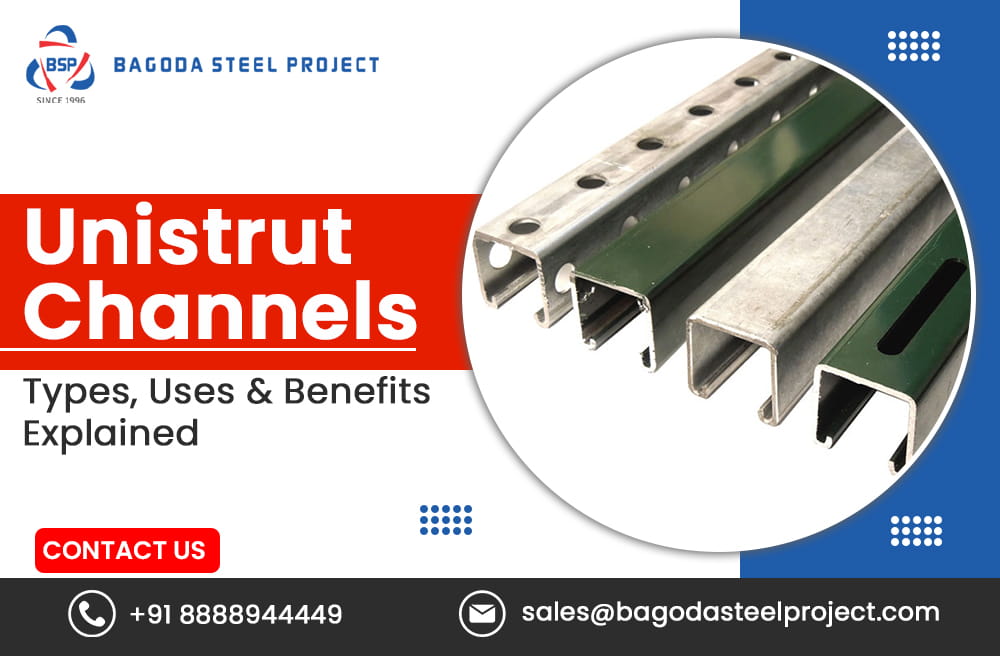
A Unistrut channel frame made of metal that is designed to make flexible support systems. The distinctive U-shaped profile features the lips facing inwards, which allow compatible spring nuts bolts, brackets, as well as other accessories to be set in the channel.
The design of the system makes it extremely flexible. Instead of welding permanent support components, installers are able to construct, modify the components, remove them and move them when project requirements change.
Unistrut-type framing systems are typically made from different materials like pre-galvanized steel and hot-dip galvanized steel, and stainless steel. The selection of materials is contingent on the requirements for load and conditions of the environment where the channel will be used.
Unistrut Channel 41 x 41: A Popular Standard Size
Unistrut Channel 41 x 41 is among the most well-known channel configurations. The dimensions are approximately 1-5/8-inch x 1-5/8 in, approximately 41 millimeters by 41 millimeters.
This family of P1000s is typically linked to the 41 x 41 mm profile. References to engineering and product specifications provide P1000 channels in various lengths and finishes, with the most common heavy-duty models using around 2.5 millimeters or 12-gauge material.
But, buyers shouldn't choose a channel solely based on its dimensions. The thickness, the steel grade, finish, slot or hole configuration and span, loading conditions, and the method of installation can all impact the performance.
Unistrut Channel P1000
The Unistrut Channel P1000 is the standard 41 x 41 millimeter single-channel profile that is utilized in a wide range of different structural applications. It is available in plain and different variations based on the model and the specifications.
P1000 channels can be utilized as supports for horizontal as well as vertical framing members, cable or pipe support structures. Tables of engineering for P1000 show that the allowable loads differ significantly with the height of the span, unsupported load arrangement, and deflection parameters. Thus, load tables published must always be reviewed prior to designing a channel in the structural use.
Types of Unistrut Channels
There are various channel configurations available to meet the needs of installation.
-
Plain or Solid Channels
Plain channels are a continuous surface that is not pre-punched. They are ideal for installers who are looking to drill or make connections at certain locations or if a smooth structure is required.
-
Slotted Channels
The slots have openings that are elongated which make positioning and adjustment simpler. They are especially helpful when the exact location of fixings can change in the course of installation.
-
Perforated or Holed Channels
They are equipped with pre-punched holes that are spaced at a predetermined interval. They make it easier to install repetitively and provide easy fixing points for certain applications.
-
Double and Combination Channels
A number of channels can be combined to form stronger or deeper framing members. Catalogues of products include combinations like P1001 and various other multi-channel configurations to meet the needs of applications that require more structural strength.
Unistrut Channel Sizes in mm
While 41 x 41 mm is among the most sought-after designs, dimensions of the Unistrut Channel in millimeters differ based on the type of channel and the application.
Common profiles include approximately:
- 41 x 41 mm
- 41 x 21 mm
- 41 x 22 mm
- 41 x 62 mm
- 41 x 82 mm as well as other combinations
For instance, product catalogs provide P1000T with 41 x 41 millimeters, P3300T with a dimension of 41 x 22 millimeters, P4000T at 41 x 21 millimeters and P5500T that measures 41 x 62 millimeters. The thickness and mass can also vary between different profiles.
The proper size should be chosen based on the span, load, installation location and the required method of connection rather than based on the dimensions only.
Unistrut Channel Length
Unistrut length of channel will vary based on the profile, manufacturer and the market. The standard lengths for commercial use are typically 3 and 6 meters and some manufacturers offer around 20 and 10 foot lengths. Cut-to-length supplies may be offered for certain projects.
For large-scale projects, order standard lengths to reduce the burden of transportation and planning inventory. But, cutting channels that are custom cut can cut down on site fabrication and waste of materials when project dimensions are set beforehand.
Role of Unistrut Brackets
Universal strut brackets are a crucial element of the entire framing system. Brackets, clamps, bolts, nuts and other fittings permit channels to be joined to ceilings, walls and floors and pipes, as well as equipment and various other structural elements.
Based on the application, brackets are suitable for:
- Supports for conduit and pipe
- Cable tray support
- HVAC installations
- Solar mounting structures
- Equipment frames
- Electrical installations
- Shelving and storage structures
- Industrial support frameworks
The benefit is the modularity. Components can be relocated or expanded without re-building the entire structure of support.
Uses of Unistrut Channels
Unistrut channels can be found in many industries. They are used in electrical systems, where they are used to support conduits, cable trays and equipment for junction. HVAC contractors employ them to support pipework, ductwork and equipment support. Plumbing projects may require pipe racks and support structures.
In industrial installations, channels make frames for equipment as well as maintenance platforms, and also flexible support frameworks. They also serve in warehouses, commercial buildings as well as factories, data centres or infrastructure construction projects.
Their ability to adapt makes them beneficial when services have to be upgraded, installed, or modified over time.
Benefits of Unistrut Channels
The most significant benefits are the flexibility of installation, reuseability, modular construction, and less fabrication of the site. Mechanical fastening may cut down or eliminate welding needs and help contractors speed up installation.
Another benefit is that it can be adjusted. Components are able to be moved along the channel or moved as layouts alter. This is especially beneficial in industrial and commercial settings in which HVAC, electrical and plumbing services can be changed in the course of building.
Options for stainless-steel or galvanized steel can also improve protection against corrosion when used in suitable conditions.
Choosing Unistrut Channel Manufacturers in India
When looking at Unistrut Channel manufacturers in India buyers must look beyond the price. It is important to consider factors such as material quality and channel thickness, as well as the accuracy of dimensional measurements, the quality of the surface, lengths available as well as slots, loads information as well as accessory compatibility and uniformity.
For projects that are located in Mumbai or across India choosing an experienced supplier like Bagoda Steel Project will assist procurement teams to identify the most appropriate channel profile and the associated components based on the project's specifications.
Unistrut channels are a flexible solution to create flexible metal support and framing systems. From the highly-rated Unistrut Channel 41x41 along with the Unistrut Channel P1000 to perforated, slotted and combined profiling, they come in various configurations to suit a range of purposes.
Understanding the sizes of Unistrut channels in millimeters and the material types, Unistrut channel length as well as load requirements for suitable brackets for Unistrut is vital to choose the appropriate system. If properly specified and installed the channels will provide a solid, flexible and dependable structure for HVAC, electrical plumbing, industrial commercial and industrial projects.
FAQ
1. What is a Unistrut Channel 41 x 41?
Unistrut Channel 41 x 41 is a steel framing channel that has an approximately 41 mm by 41 millimeter cross-section. This series of profiles is typically associated with this profile and employed for structural and service support applications.
2. What exactly is Unistrut Channel P1000 for?
The Unistrut Channel P1000 can be widely used to support pipe, cable tray, HVAC systems, electrical installations, equipment supports as well as modular framing. The actual capacity of the channel is contingent on span, load materials, and the installation conditions.
3. What are the most common Unistrut dimensions of the channel in millimeters?
Common profiles comprise approximately 41 x 41 mm, 41 x 21 mm, 41 x 22 millimeters and 41 x 62 mm and other combinations are available for specialized uses.
4. What is the normal Unistrut length of the channel?
Common lengths are between 3 meters and 6 metres. Some suppliers provide 20-foot and 10-foot lengths, as well as cut-to-length service. The availability of these lengths varies according to manufacturer and profile.
5. How do I select Unistrut Channel manufacturers in India?
Compare suppliers based on material quality, measurements, thickness and available sizes for channels and accessories, technical documentation, load data, customization options, and delivery capabilities. Specifications for industrial needs should be confirmed prior to placing an order.
