
Where Are Polypropylene Tubes Used? A Look at Industrial Applications?
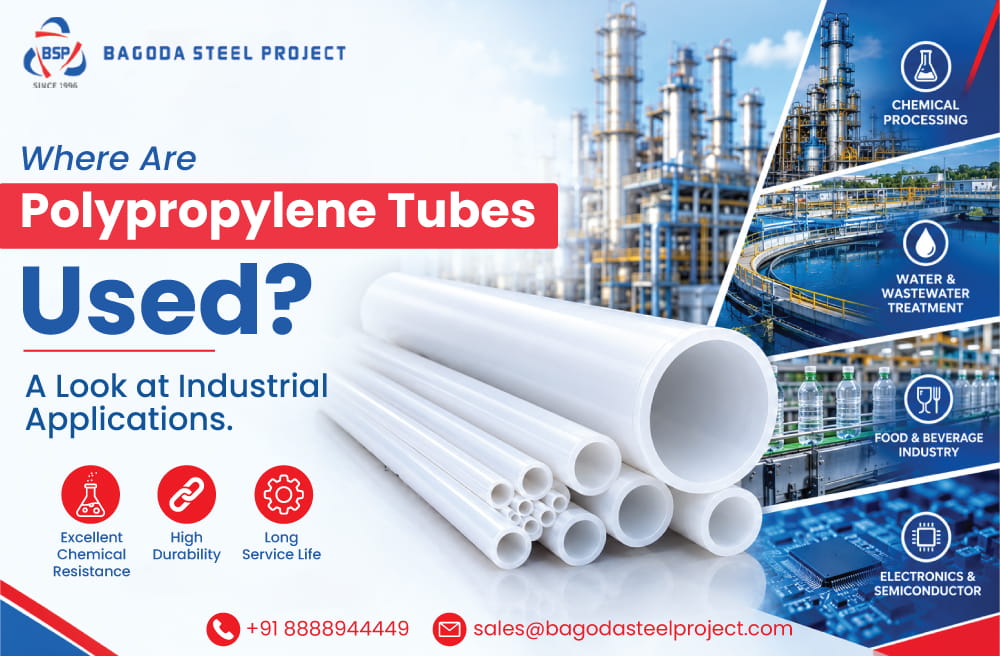
Where Are Polypropylene Tubes Used? A Look at Industrial Applications?
In modern industries, the right material can make a significant difference to operational efficiency, product quality, and long-term maintenance costs. While metals and conventional plastics continue to serve important purposes, polypropylene has established itself as a reliable material for applications that require chemical resistance, lightweight construction, and dependable performance. From chemical processing plants to water treatment facilities, polypropylene tubes support several industrial operations where material selection matters.
At Bagoda Steel Project, we understand that industrial buyers look beyond the initial purchase price. They need materials that suit their operating conditions, offer consistent quality, and contribute to reliable system performance. This is why polypropylene tubes have become an important consideration for engineers, procurement professionals, and industrial manufacturers.
But where are polypropylene tubes used, and what makes them suitable for such a wide range of applications? Let us explore their key industrial uses and the factors businesses should consider when sourcing them.
What Are Polypropylene Tubes?
Polypropylene tubes are hollow cylindrical products manufactured from polypropylene, a thermoplastic polymer known for its chemical resistance, low weight, and moisture resistance. Depending on their formulation, dimensions, and manufacturing process, these tubes can be used for fluid transfer, protective applications, laboratory equipment, and specialised industrial systems.
One of their main advantages is their resistance to many acids, alkalis, and other chemicals. However, compatibility depends on the specific chemical, its concentration, operating temperature, and exposure conditions.
For businesses evaluating polypropylene tube manufacturers, understanding the intended application is essential. A tube suitable for water handling may not necessarily be appropriate for a high-temperature chemical process or a pressurised industrial system.
Chemical Processing and Manufacturing
Chemical processing is one of the most important application areas for polypropylene tubes. Industrial plants regularly handle corrosive liquids, cleaning solutions, acids, and alkaline chemicals that may damage unsuitable materials.
Polypropylene offers resistance to many commonly used industrial chemicals, making it useful in selected chemical transfer lines, process equipment, laboratory connections, and fluid-handling systems.
For example, a manufacturing facility handling compatible chemical solutions may consider polypropylene tubing to reduce corrosion-related maintenance compared with an unsuitable metallic material. Its lightweight construction can also simplify handling and installation.
However, polypropylene is not universally resistant to every chemical. Engineers must verify chemical compatibility, temperature limits, pressure ratings, and applicable safety requirements before selecting a tube.
Water Treatment and Wastewater Management
Water treatment plants require reliable systems for handling water, treatment chemicals, and process fluids. Polypropylene tubes can be used in selected dosing arrangements, chemical feed systems, sampling lines, and auxiliary fluid-handling applications.
Their resistance to moisture and many treatment chemicals makes them useful in appropriate operating conditions. Their relatively low weight can also make installation and maintenance more manageable.
In wastewater treatment, where equipment may encounter variable chemical compositions, the correct tube specification becomes especially important. Buyers should evaluate the nature of the fluid, exposure duration, operating temperature, and expected pressure.
For water treatment operators, choosing the right tubing is not simply about transporting liquids. It is about maintaining process reliability while avoiding premature material failure.
Pharmaceutical and Laboratory Applications
Pharmaceutical production and laboratory environments require materials suited to specific hygiene, purity, and chemical-handling requirements. Polypropylene tubes may be used in laboratory equipment, sample handling, selected fluid-transfer arrangements, and compatible process applications.
Their chemical resistance and lightweight structure can make them practical for certain laboratory operations. Polypropylene is also available in grades designed for specialised uses, although not every grade is appropriate for pharmaceutical manufacturing.
Where product contact, sterility, or contamination control is critical, buyers must confirm that the material meets the relevant regulatory, cleanliness, and validation requirements. Sterilisation compatibility should also be verified for the particular tube grade and process.
For pharmaceutical manufacturers, the objective is to select tubing that meets the precise requirements of the application rather than assuming that every polypropylene product offers the same performance.
Food and Beverage Processing
Food and beverage facilities use tubing and piping systems for various processing, transfer, and auxiliary operations. Polypropylene may be suitable for selected applications involving compatible liquids, cleaning solutions, and process fluids.
Its moisture resistance and ability to withstand many chemicals can be advantageous in suitable environments. Nevertheless, food-contact compliance must be established for the specific material and intended use.
Factors such as cleaning procedures, temperature fluctuations, pressure, and contact with food ingredients influence material selection. A tube intended for general industrial service should not automatically be considered suitable for direct food contact.
Businesses sourcing from polypropylene tube manufacturers should request relevant material documentation and verify that the product meets applicable food-safety requirements.
Automotive and Engineering Industries
The automotive and general engineering sectors use polymer components in a wide variety of supporting applications. Polypropylene tubes may be considered for protective sleeves, selected fluid-handling arrangements, component housings, and other applications where their properties meet the design requirements.
Their lightweight nature can help reduce component weight, while their resistance to moisture and many chemicals can provide advantages in suitable environments.
However, automotive applications may involve vibration, impact, temperature variation, and exposure to oils or fuels. These conditions require careful compatibility testing because polypropylene is not suitable for every automotive fluid or operating environment.
Manufacturers must therefore evaluate mechanical strength, dimensional accuracy, thermal performance, and the tube's intended service conditions before finalising a material specification.
Electrical and Industrial Equipment
Polypropylene is used in selected industrial equipment and electrical applications because it offers useful insulating properties, low weight, and resistance to moisture. Tubular products may serve as protective components, insulating elements, or parts of specialised equipment, depending on their design.
In these applications, dimensional consistency and the appropriate electrical and mechanical properties are important. Where fire resistance, flame retardancy, or specific electrical certifications are required, the selected grade must be independently verified against the applicable standards.
The suitability of polypropylene tubing depends on the equipment design and its operating environment, rather than the material name alone.
Agriculture and Irrigation Systems
Agricultural operations require practical solutions for water distribution, fertigation, and selected chemical-dosing applications. Polypropylene tubes may be used in compatible auxiliary systems, laboratory testing equipment, and certain fluid-transfer arrangements.
Their lightweight construction can simplify handling, while their resistance to moisture and various chemicals can be useful in appropriate applications.
However, polypropylene tubing should not automatically be substituted for purpose-designed irrigation pipes or pressure-rated distribution systems. Exposure to sunlight, fertilisers, pesticides, pressure fluctuations, and outdoor temperatures must be considered.
Agricultural buyers should confirm that the selected product is designed for the required service conditions and expected operating life.
How to Choose the Right Polypropylene Tube Manufacturers
Selecting a supplier involves more than comparing prices. Industrial buyers should evaluate the following factors before placing an order:
- Material quality: Confirm the polypropylene grade and request relevant technical documentation.
- Dimensions and tolerances: Check the required outer diameter, inner diameter, wall thickness, and dimensional consistency.
- Chemical compatibility: Verify suitability for the actual fluid, concentration, and operating temperature.
- Pressure and temperature ratings: Ensure that the tube is designed for the intended working conditions.
- Application requirements: Confirm any food-contact, pharmaceutical, electrical, or other industry-specific standards.
- Supply reliability: Assess product availability, consistency, lead times, and the supplier's ability to meet project specifications.
At Bagoda Steel Project, material selection begins with understanding the practical requirements of an industrial application. A well-informed purchasing decision can help businesses minimise avoidable maintenance, improve equipment reliability, and choose products that fit their operational needs.
Conclusion
Polypropylene tubes serve a diverse range of industrial applications, including chemical processing, water treatment, laboratories, food processing, engineering, electrical equipment, and agriculture. Their lightweight construction, moisture resistance, and compatibility with many chemicals make them useful where operating conditions are appropriate.
However, no single tube material is ideal for every application. Chemical exposure, pressure, temperature, mechanical stress, and regulatory requirements must guide the final decision.
For businesses exploring polypropylene tube manufacturers, the best approach is to prioritise material specifications, application suitability, and dependable supply rather than price alone. With careful evaluation and the right technical guidance, industries can select tubing solutions that support efficient and reliable operations.
FAQ
1. Where are polypropylene tubes commonly used?
Polypropylene tubes are used in chemical processing, water treatment, laboratories, selected pharmaceutical and food-processing applications, industrial equipment, and certain agricultural systems. Their suitability depends on the material grade and operating conditions.
2. Why are polypropylene tubes preferred for chemical applications?
Polypropylene offers resistance to many acids, alkalis, and industrial chemicals. It is also lightweight and resistant to moisture. However, compatibility must be checked for each chemical, concentration, and operating temperature.
3. How do businesses select reliable polypropylene tube manufacturers?
Businesses should assess material quality, dimensional accuracy, technical documentation, chemical compatibility, pressure and temperature ratings, product availability, and compliance with relevant industry standards.
4. Are polypropylene tubes suitable for high-temperature applications?
Polypropylene can withstand certain elevated temperatures, but its strength and dimensional stability decrease as temperature increases. The permissible operating temperature depends on the grade, pressure, duration of exposure, and application.
5. Can polypropylene tubes be used in food and pharmaceutical industries?
Yes, selected grades can be suitable for specific food and pharmaceutical applications. Buyers must verify food-contact compliance, cleanliness, chemical compatibility, sterilisation suitability, and any relevant regulatory requirements before use.
