
Pipe Fitting Dimensions Explained: Size, Schedule, Thickness & Pressure Ratings
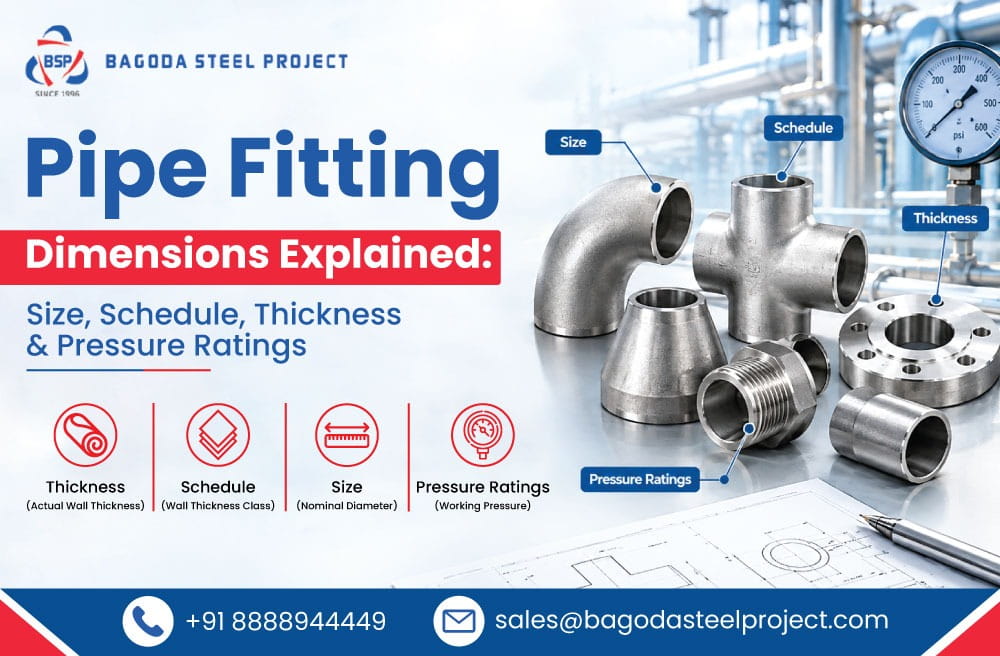
Pipe Fitting Dimensions Explained: Size, Schedule, Thickness & Pressure Ratings
Knowledge of pipe fittings dimensions is crucial for the selection of the appropriate pipe fittings for industrial piping systems. Elbows, tees, reducers, caps, and other butt-weld pipe fittings have compatibility, flow, mechanical and installation characteristics that depend on dimensions.
Understanding pipe dimensions, pipe wall thickness, pipe schedules, and pressure ratings can help engineers, procurement teams, fabricators, and maintenance professionals avoid leaks, premature failures, and expensive installation issues.
In the context of providing piping components for challenging industrial applications, it is essential to grasp dimensional requirements at Bagoda Steel Project.
Pipe Fitting Dimensions – What Are They?
Pipe fitting dimensions are the physical dimensions used to identify and produce a pipe fitting. These may include nominal pipe size (NPS), outside diameter (OD), inside diameter (ID), wall thickness, center-to-end dimensions, overall length, and connection dimensions.
Common pipe fittings include:
- Elbows
- Equal and reducing tees
- Concentric and eccentric reducers
- Pipe caps
- Crosses
- Stub ends
- Other specialty fittings, such as couplings
In the case of welded piping systems, dimensions must conform with the pipe and the applicable manufacturing standard for fit-up and welding.
Why Is It Important to Use the Right Size Pipe?
The fittings should be the correct size for the pipe they will be joined to; if they are not, issues in installation and performance may result.
Dimensions influence:
- Compatibility: The fitting needs to correspond with the size and type of pipe.
- Flow: Internal diameter has an impact on fluid flow and pressure drop.
- Strength: Wall thickness is associated with resisting pressure and mechanical loads.
- Welding: Butt-weld fittings must have suitable end sizes for correct joint preparation.
Correct dimensions reduce the risk of misalignment, leakage and premature failure, supporting overall system reliability. Selection should always consider the application, material, pressure, temperature and applicable standards.
Standard Sizes for Pipes
For technical specifications, drawings, fabrication and procurement, pipe size in mm is commonly used for engineering applications in India and many other international applications.
Sizes are often specified in terms of Nominal Pipe Size (NPS) or Nominal Bore (NB), rather than by outside diameter. A pipe can be specified as DN 50 or NPS 2, for instance — DN being the nominal metric diameter designation and NPS the inch-based nominal designation.
The actual outside diameter may not be exactly equal to the nominal size, and diameters are typically measured in inches. That is why it is important for engineers to use the relevant dimensional standard, rather than assuming that nominal size is the same as the measured diameter.
What Does Pipe Schedule Mean?
Pipe schedule is a system used to designate pipe wall thickness. Common schedules include:
- SCH 5
- SCH 10
- SCH 20
- SCH 40
- SCH 80
- SCH 120
- SCH 160
There are different schedules for the same nominal pipe size, and generally, as the schedule increases, so does the wall thickness. For instance, a DN/NPS 2 pipe made in SCH 40 will have a different wall thickness than another DN/NPS 2 pipe made in SCH 80.
It is important to note that pipe schedule is not a true pressure rating. Allowable pressure depends on material grade, temperature, design code, dimensions, manufacturing requirements, corrosion allowance and other engineering parameters.
How Does Wall Thickness Impact Pipe Fittings?
When choosing fittings, one of the primary factors to consider is wall thickness. The ends of the fittings must be suitable for butt-weld pipe and welding, and fittings can be made with various wall thickness designs, such as standard, heavy or special application designs.
A thicker wall can offer higher resistance to internal pressure and mechanical stresses, but will also have an impact on:
- Welding preparation
- Weight
- Cost
- Flow area
- Installation requirements
It is therefore insufficient to choose a suitable fitting by a simple choice of wall thickness alone — a comprehensive piping design assessment is needed.
What Factors Influence Tee Joint Pipe Fitting Sizes?
A tee joint pipe fitting is used for creating a branch connection in a pipe system. There are two types of tees generally available: equal tees and reducing tees.
Key tee joint pipe fitting specifications include:
- Nominal pipe size
- Branch size
- Outside diameter
- Wall thickness
- Center-to-end dimensions
- Overall dimensions
- End preparation
The nominal size of the tee is the same for both the run and branch for an equal tee, and smaller for the branch in a reducing tee. A reducing tee, for example, joins a large pipe to a smaller pipe, with specific sizes based on the applicable standard and size.
Buttweld Pipe Fitting Dimensions: What Are They?
Pipe fittings designed to connect to pipe by butt welding are measured by the buttweld pipe fitting dimension. The most common buttweld fittings are elbows and tees, available in 45° and 90° angles; reducers change the diameter of the piping; and caps attach to the end of the pipe.
Their dimensional specification can include:
- Nominal size
- Outside diameter
- Wall thickness
- Center-to-end dimensions
- End-to-end dimensions
- Bevel dimensions
- Radius for elbows
- Branch dimensions for tees
Factory-made wrought butt-welding fittings are often required to conform to a standard like ASME B16.9, though the applicable standard should always be checked for the particular product and project.
When to Verify Pipe Fitting Dimensions
Pipe fitting dimensions should be checked when designing, procuring, manufacturing, installing, inspecting and carrying out maintenance.
To avoid ordering the wrong fittings, engineers and buyers should verify:
- Required nominal size
- Pipe outside diameter
- Applicable schedule or wall thickness
- Material grade
- Fitting type
- Pressure and temperature conditions
- Applicable dimensional standard
- End connection
- Corrosion allowance (where applicable)
- Project-specific specifications
Dimensional drawings and technical datasheets should always be confirmed before manufacturing or installation.
What is the relationship between the pressure rating and the pipe dimensions?
The pressure capability is more closely related to several factors and not just the dimensions.
The pressure at which a piping component can be used may be influenced by:
Material + wall thickness + diameter + heat + design code + manufacturing standard + corrosion allowance
The thickness of the walls can be increased to increase their pressure resistance but the overall system needs to be assessed based on the relevant engineering code.
Pressure-temperature rating may also be influenced by the classification, material, standard, and design for fittings. Thus, it is not intended that users can automatically assume that a specific schedule is associated with a specific pressure rating.
Understanding pipe fitting dimensions, pipe dimensions, pipe dimensions in mm, tee joint pipe fitting dimensions, and buttweld pipe fitting dimensions is fundamental to building safe and reliable piping systems.
Nominal size identifies the general pipe size, while outside diameter, wall thickness, schedule, fitting geometry, and end preparation provide the detailed dimensional information needed for engineering and fabrication. Pressure capability must be assessed using the complete material, dimensional, temperature, and design-code requirements rather than schedule alone.
For industrial piping projects, accurate dimensional specifications and appropriate material selection can help improve installation efficiency, operational reliability, and long-term performance. Bagoda Steel Project can support project requirements involving industrial piping components and steel solutions with attention to application-specific specifications.
Why Choose Bagoda Steel Project?
Understanding pipe fitting dimensions, pipe dimensions in mm, tee joint pipe fitting dimensions, and buttweld pipe fitting dimensions is fundamental to building safe and reliable piping systems. Nominal size identifies the general pipe size, while outside diameter, wall thickness, schedule, fitting geometry, and end preparation provide the detailed information needed for engineering and fabrication.
Pressure capability must be assessed using the complete material, dimensional, temperature, and design-code requirements rather than schedule alone. For industrial piping projects, accurate dimensional specifications and appropriate material selection can help improve installation efficiency, operational reliability, and long-term performance.
Bagoda Steel Project can support project requirements involving industrial piping components and steel solutions with attention to application-specific specifications. Customers can get in touch with our team to discuss dimensional and material requirements for their projects.
FAQ
1. What are pipe fitting dimensions?
Pipe fitting dimensions are the measurements used to specify a fitting, including nominal size, outside diameter, wall thickness, center-to-end dimensions, and end preparation.
2. What are pipe dimensions in mm?
Pipe dimensions in mm generally refer to measurements such as outside diameter, inside diameter, wall thickness, and fitting length expressed in millimetres. Nominal pipe size may still be specified using NPS or DN.
3. What does pipe schedule mean?
Pipe schedule identifies the wall thickness category of a pipe. Common schedules include SCH 10, SCH 40, SCH 80, and SCH 160.
4. What are tee joint pipe fitting dimensions?
Tee joint pipe fitting dimensions include nominal run and branch sizes, outside diameter, wall thickness, center-to-end dimensions, and end preparation. Equal and reducing tees have different dimensional configurations.
5. What are buttweld pipe fitting dimensions?
Buttweld pipe fitting dimensions include nominal size, outside diameter, wall thickness, center-to-end or end-to-end dimensions, elbow radius where applicable, and weld-end preparation. The exact dimensions depend on the applicable standard and size.
