
Why PEEK Tubing Is Trusted for High-Temperature Applications?
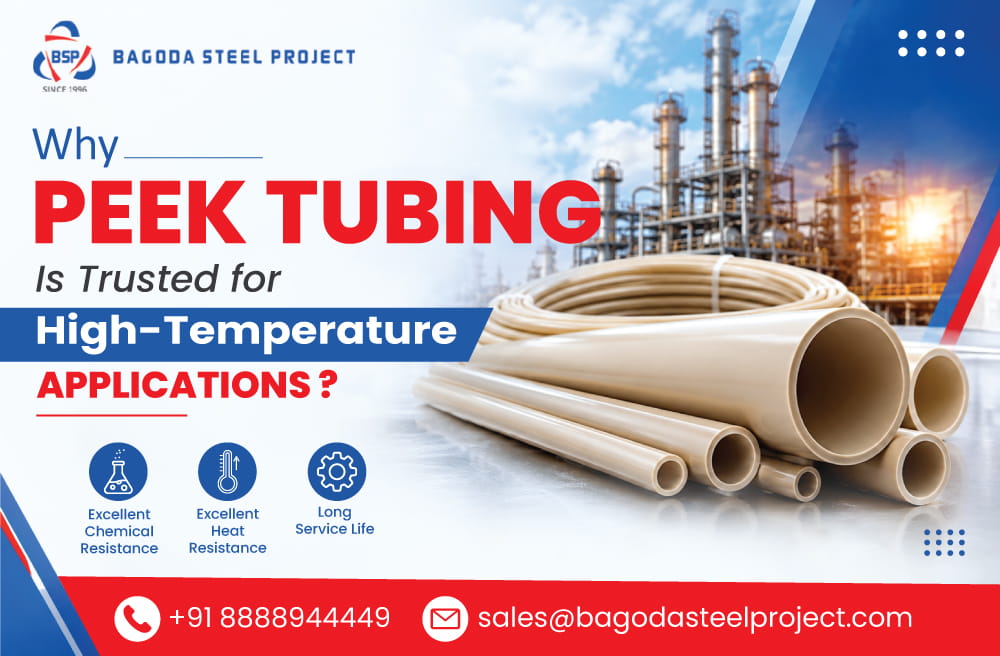
Why PEEK Tubing Is Trusted for High-Temperature Applications?
In industries where high temperatures, chemical exposure, and demanding operating conditions are part of everyday operations, choosing the right tubing material is essential. A tubing system must do more than transport fluids or gases; it must maintain dimensional stability, withstand mechanical stress, and deliver consistent performance over time. This is where PEEK tubing has earned a strong reputation across industrial and engineering applications.
PEEK, or Polyether Ether Ketone, is a high-performance thermoplastic known for its excellent thermal stability, mechanical strength, and chemical resistance. From chemical processing plants to aerospace systems and advanced medical equipment, PEEK tubing is valued for applications where conventional plastic tubing may not provide the required reliability.
At Bagoda Steel Project, we understand that selecting the right material involves balancing operating temperature, pressure requirements, chemical compatibility, and long-term performance. Understanding why PEEK tubing is trusted for high-temperature applications helps engineers, procurement professionals, and industrial buyers make informed decisions.
What Is PEEK Tubing?
PEEK tubing is manufactured from Polyether Ether Ketone, a semi-crystalline engineering thermoplastic designed for demanding operating environments. Unlike standard polymer tubing, PEEK offers a combination of thermal resistance, rigidity, wear resistance, and chemical stability.
One of its most important characteristics is its ability to retain useful mechanical properties at elevated temperatures. Depending on the grade, dimensions, pressure, and operating conditions, PEEK can support applications involving continuous exposure to temperatures approaching 250°C.
However, the actual performance limit depends on the tubing specification, the surrounding environment, and the manufacturer's recommendations. Temperature resistance alone should never be treated as a guarantee of pressure-bearing capability.
For industries that require dependable fluid transfer and precision engineering, working with a reliable PEEK tubing manufacturer is an important step towards achieving consistent product quality.
Excellent Resistance to High Temperatures
The primary reason PEEK tubing is trusted in demanding industrial environments is its exceptional thermal performance.
Many conventional plastics soften, deform, or lose mechanical strength when exposed to elevated temperatures. PEEK, by comparison, maintains useful structural and mechanical properties across a much wider temperature range.
Its melting point is approximately 343°C, while continuous service temperatures are commonly specified around 250°C for suitable grades under appropriate conditions. These figures describe different properties: the melting point is not the recommended operating temperature.
This distinction matters in practical applications. Engineers must consider pressure, thermal cycling, exposure duration, and the consequences of material failure before specifying tubing for a high-temperature system.
For example, industrial equipment handling heated process fluids may require tubing that retains its shape and mechanical integrity during prolonged operation. PEEK can be a suitable candidate when the design and operating conditions align with its material capabilities.
Mechanical Performance Under Stress
High-temperature environments frequently expose tubing to more than heat alone. Pressure fluctuations, vibration, repeated movement, and mechanical loading can also influence performance.
PEEK is known for its high tensile strength, stiffness, and resistance to creep compared with many conventional thermoplastics. Creep refers to the gradual deformation of a material under sustained stress.
These properties can be particularly useful in precision fluid-handling systems, analytical instruments, and industrial equipment where maintaining dimensional accuracy is important.
For procurement teams, the practical consideration is straightforward: tubing should be selected according to the application's actual pressure and temperature requirements rather than relying solely on a material's general reputation.
A knowledgeable PEEK tubing manufacturer should be able to provide relevant dimensional tolerances, grade information, and technical specifications to support this evaluation.
Reliable Chemical Resistance
Industrial tubing often comes into contact with oils, solvents, fuels, process chemicals, and other aggressive substances. The wrong material may swell, crack, weaken, or contaminate the transported medium.
PEEK provides broad resistance to many chemicals, making it suitable for numerous demanding fluid-handling applications.
This resistance can help support longer service life and reduce the frequency of tubing replacement when the material is correctly matched to the operating environment.
Nevertheless, PEEK is not universally resistant to every chemical. Certain concentrated acids, strong oxidising agents, and specific chemical combinations can affect its performance, particularly at elevated temperatures.
Before selecting PEEK tubing, engineers should verify chemical compatibility at the intended concentration and operating temperature. This is especially important in chemical processing, laboratory equipment, and specialised manufacturing environments.
Dimensional Stability and Low Moisture Absorption
Dimensional stability is an important consideration in systems where accurate measurements, consistent flow, and dependable connections are essential.
PEEK absorbs relatively little moisture compared with many engineering polymers. This characteristic helps it maintain dimensional consistency across a range of operating environments.
For applications involving precision instruments or analytical equipment, dimensional stability can contribute to predictable system performance.
Tubing dimensions, wall thickness, tolerances, and connection design must still be checked against the application requirements. Even a high-performance polymer can underperform when incorrectly sized or installed.
Wear Resistance and Long-Term Durability
Tubing used in demanding environments may experience friction, repeated movement, or contact with flowing media containing abrasive particles.
PEEK offers good wear resistance and fatigue performance in suitable applications. These characteristics can make it useful in equipment that operates continuously or experiences repeated mechanical cycles.
Its durability may help reduce maintenance requirements and replacement frequency, although actual service life depends on the operating environment, installation quality, and exposure to mechanical and chemical stresses.
For businesses evaluating the total cost of ownership, the initial purchase price should therefore be considered alongside expected service life, maintenance needs, and the consequences of unplanned downtime.
Where Is PEEK Tubing Commonly Used?
PEEK tubing is used across several industries where thermal stability, chemical resistance, and mechanical performance are important.
Common applications include:
- Chemical processing: Fluid transfer and specialised process equipment, subject to chemical compatibility.
- Aerospace and automotive engineering: Selected high-performance fluid systems and components.
- Analytical laboratories: Chromatography and other precision fluid-handling equipment.
- Oil and gas: Specialised instrumentation and fluid-handling applications where material specifications permit.
- Medical and pharmaceutical equipment: Selected systems requiring suitable material grades, validated compatibility, and applicable regulatory compliance.
- Electronics manufacturing: Precision equipment and processes involving controlled fluid delivery.
The correct choice depends on temperature, pressure, chemical exposure, cleanliness requirements, and the relevant industry standards.
How to Choose the Right PEEK Tubing Manufacturer
Finding the right supplier is just as important as identifying the right material. A dependable PEEK tubing manufacturer should help buyers verify whether the product meets their application's technical requirements.
At Bagoda Steel Project, industrial buyers should consider the following factors when evaluating tubing suppliers:
- Material specifications: Confirm the PEEK grade and request relevant technical documentation.
- Dimensional accuracy: Check the required outer diameter, inner diameter, wall thickness, and tolerances.
- Operating conditions: Verify pressure ratings at the intended temperature rather than relying on room-temperature figures.
- Quality assurance: Review available inspection reports, traceability documentation, and applicable quality certifications.
- Application support: Seek clarification about chemical compatibility, installation requirements, and operating limitations.
- Supply consistency: Confirm availability, delivery schedules, and the supplier's ability to meet repeat-order requirements.
A supplier that provides clear technical information helps reduce uncertainty during material selection and supports more informed procurement decisions.
Conclusion
PEEK tubing has become a trusted option for high-temperature applications because it combines thermal stability, mechanical strength, chemical resistance, dimensional consistency, and wear resistance. These properties make it a valuable engineering material for industries where ordinary tubing materials may not meet demanding operating requirements.
However, successful material selection requires more than choosing a polymer with an impressive temperature rating. Engineers must evaluate pressure, chemical exposure, operating duration, and the requirements of the complete tubing system.
For industrial buyers working with Bagoda Steel Project, understanding these factors can help simplify procurement decisions and improve application suitability. By consulting a reliable PEEK tubing manufacturer and verifying the relevant technical specifications, businesses can identify tubing solutions that support dependable performance in challenging industrial environments.
FAQ
1. What is PEEK tubing used for?
PEEK tubing is used in chemical processing, analytical instruments, specialised fluid-handling systems, aerospace engineering, automotive applications, and selected medical and pharmaceutical equipment. Its suitability depends on the grade and operating conditions.
2. What is the maximum temperature PEEK tubing can withstand?
Suitable PEEK grades are commonly associated with continuous service temperatures of approximately 250°C under specified conditions. The melting point is around 343°C, but this is not a recommended operating temperature. Pressure, exposure duration, and chemical compatibility must also be evaluated.
3. Why is PEEK tubing preferred over conventional plastic tubing?
PEEK tubing offers a combination of high-temperature performance, mechanical strength, chemical resistance, low moisture absorption, and wear resistance. These properties can make it more suitable than conventional plastics for demanding industrial applications.
4. How do buyers select a reliable PEEK tubing manufacturer?
Buyers should assess material grades, dimensional tolerances, technical documentation, quality assurance, pressure and temperature ratings, chemical compatibility, and supply consistency. Application-specific technical support is also valuable when selecting a manufacturer or supplier.
5. Is PEEK tubing resistant to chemicals?
PEEK resists many industrial chemicals, oils, and solvents. However, it is not compatible with every chemical under all conditions. Buyers should verify compatibility at the actual operating temperature, concentration, and exposure duration before specifying PEEK tubing.
