
Industrial Piping Corrosion: Types, Causes, Prevention & Material Selection
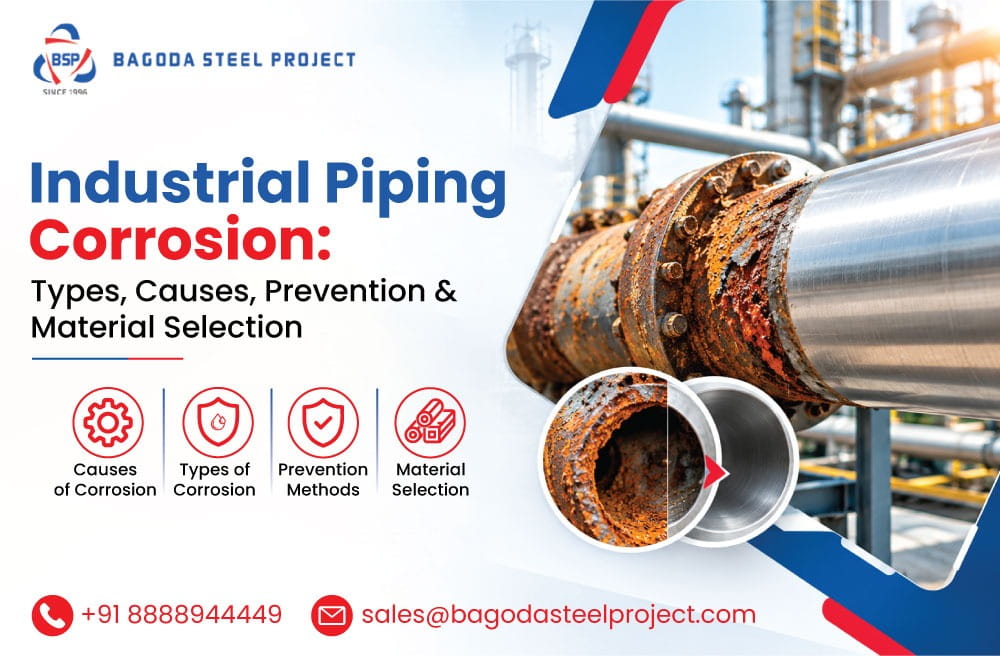
Industrial Piping Corrosion: Types, Causes, Prevention & Material Selection
Industrial piping systems are used to move water, chemicals, oil, gas, steam and other process fluids. Industrial piping can become corroded over a long period of time due to exposure to moisture, chemicals, oxygen, temperature changes, and mechanical stresses. Corrosion can thin pipe walls, introduce contaminants into the fluid, cause leaks, drive up maintenance expenses, and cause system failures.
In order to ensure safe and reliable piping systems, therefore, it is important to understand the types of pipe corrosion, its causes, prevention strategies, and materials of construction. Hence we at Bagoda Steel Project offer you this blog.
What is Industrial piping corrosion?
Industrial piping corrosion is corrosion of a pipe or any part of a pipe caused by chemical or electrochemical reactions between that pipe or pipe part and its surroundings. Carbon steel and other metallic materials are especially susceptible to attack by water, oxygen, acids, salts and aggressive chemicals.
The mechanism and rate of corrosion will be influenced by the metallic element of the pipe, the composition of the fluid, fluid temperature and pressure, fluid velocity, pH, contaminants, and operating conditions.
Pipe Corrosion: What Causes It?
Pipe corrosion typically results from the combination of the pipe material being susceptible to corrosion and the corrosive environment coming into contact with the pipe. The electrochemical corrosion can be caused by water and oxygen, and the acids or other chemicals can directly attack metallic surfaces.
Common causes include:
- The exposure to moisture and oxygen. Exposure to moisture and oxygen.
- Low or high pH
- Dissolved salts and chlorides
- Acidic process fluids
- High operating temperatures
- Excessive fluid velocity
- Water or liquids that don't move.
- Microbiological activity
- When dissimilar metals are brought into contact with each other.
- Erosion and wear due to mechanical damage.
- Lack of drainage, standing water.
- Inadequate protective coatings
The specific operating environment is key in determining a piping material to resist corrosion in industrial applications.
What are the principal corrosion types of pipes?
There are many different types of corrosion that occur in different environments. There are several types of pipe corrosion that are common:
-
Uniform Corrosion
Uniform corrosion is spread over a relatively large surface area of the pipe at a relatively uniform rate. It slowly thins out the overall wall thickness and is often caused by water or oxygen (and sometimes chemicals).
-
Pitting Corrosion
Pitting causes tiny cavities or holes in the metal. The area of the pipe that is affected can be quite small, but deep pits can cause the pipe to leak.
Materials that are susceptible to corrosion in chloride containing environments can pose a significant problem.
-
Crevice Corrosion
Crevice corrosion takes place in areas where corrosive liquids can be trapped, such as under deposits, gaskets, washers, pipe fittings, etc. Poor water movement can result in pockets of corrosive conditions that increase corrosion rates.
-
Galvanic Corrosion
Galvanic corrosion is the corrosion that takes place when two different metals are electrically joined and the electrolyte is present. One of the metals is more vulnerable to corrosion and the other one is relatively protected.
This risk can be minimized through proper material compatibility and isolation.
-
Erosion-Corrosion
Erosion corrosion is a combination of mechanical wear and chemical corrosion. Material can be lost by high velocity fluid flow, turbulence, suspended particles, and sudden changes in direction of flow.
-
Stress Corrosion Cracking
Stress corrosion cracking is the combination of tensile stress and corrosive environment, which can result in cracks that may grow through the material.
This mechanism is especially crucial in applications such as chemical, petrochemical, and energy applications.
-
Microbiologically Influenced Corrosion
Microorganisms may cause corrosion as a result of the formation of chemical environments or biofilm on the inside of the pipe. This is often referred to as microbiologically influenced corrosion (MIC).
When Is Pipe Corrosion Most Likely to Occur?
The more corrosive the environment in which pipes are used and the more likely they are to be poorly supervised, the more likely they are to be subject to corrosion. There are times when risks are increased, such as:
- Water treatment systems
- Chemical processing plants
- Oil and gas facilities
- Petrochemical plants
- Marine environments
- Power generation facilities
- Wastewater systems
- Cooling-water systems
- Food and pharmaceutical processing. Food and pharmaceutical processing.
- Underground piping networks
Corrosion rates may be affected by factors such as temperature, pressure, fluid concentration, fluid velocity, and operating cycles.
Here are a few steps that can be taken to prevent corrosion in industrial piping:
Prevention of corrosion should start with designing the system and not when it is damaged. Multiple methods can be used in combination, depending on the application.
Material Selection
One of the most critical corrosion-control choices is the type of pipe to select. These may be improved by using stainless steels, nickel alloys, duplex stainless steels and other special alloys in particular environments.
The proper selection is based on the chemistry of the fluid, temperature, chloride content, mechanical needs and industry standards.
These are coatings and linings that guard against corrosion, scuffing, and other damage.
A barrier between pipe and corrosive environment is possible by using internal or external coatings. The long-term performance requires proper surface preparation, choice of coating, application and inspection.
Corrosion Inhibitors
Check the metal surface to prevent electrochemical reactions and so minimize corrosion: Chemical inhibitors can be used in some water and process systems.
Catholic Protection
Some metallic piping systems, especially those that are buried or underwater, may be protected catholically. The approach helps to minimize the likelihood of oxidation of the protected metal.
Control of Water Chemistry
The pH, dissolved oxygen, chloride, temperature, and any other water quality parameters that are controlled can help minimize corrosion in water systems.
Inspection and Monitoring
Wall-thickness loss, pitting, cracking, leaks and coating deterioration can all be detected and resolved before becoming a huge problem, thanks to regular inspection. Corrosion-management programs may include techniques like ultrasonic thickness measurement and visual inspection.
Prevent Corrosion in Water Pipes
Industrial, commercial, and municipal water pipe systems are especially concerned with how to prevent corrosion in pipes.
This can be achieved through effective measures such as:
- Choosing pipe material suitable to water chemistry.
- Controlling water pH and corrosive contaminants.
- Reducing unnecessary stagnation.
- If appropriate, control the dissolved oxygen.
- Appropriate use of corrosion inhibitors as necessary.
- Protective coatings or lining.
- Prevention of contact between incompatible metals and electricity.
- Maintaining proper flow conditions.
- Periodic corrosion checks of pipes.
- Removal of worn out areas prior to failure.
A corrosion-control strategy should always be based on water chemistry since different pipe materials can respond in different ways to different water.
Who to choose the corrosion resistant piping materials?
Qualified engineers, designers, corrosion experts and experienced piping suppliers should be involved in material selection. The decision should not be based on the apparent strength, or cost, of a material, but on the entire operating conditions.
For instance, nickel based alloys can be used in high temperature or corrosive environments, and stainless steel or duplex stainless steel can be used in environments where high corrosion resistance is desired.
Fasteners, flanges, fittings, valves, and other components should also be compatible with the selected piping material and service environment.
Which Materials Can Resist Pipe Corrosion?
There is no single material that is universally resistant to every type of corrosion. Common material categories include:
- Carbon steel: Economical and widely used but often requires corrosion protection in aggressive environments.
- Stainless steel: Provides corrosion resistance for many industrial applications.
- Duplex stainless steel: Combines high strength with strong resistance to several forms of corrosion.
- Nickel alloys: Suitable for demanding environments involving high temperatures and aggressive chemicals.
- Specialty alloys: Selected for specific combinations of chemical, thermal, and mechanical requirements.
Material selection should consider corrosion resistance alongside strength, fabrication requirements, temperature capability, availability, lifecycle cost, and applicable standards.
Conclusion
Industrial piping corrosion can significantly affect the safety, reliability, efficiency, and operating costs of piping systems. Understanding the different pipe corrosion types—including uniform, pitting, crevice, galvanic, erosion-corrosion, stress corrosion cracking, and microbiologically influenced corrosion—helps engineers identify potential failure mechanisms.
Effective prevention combines appropriate material selection, protective coatings, water and process-fluid control, corrosion inhibitors, cathodic protection where applicable, and regular inspection.
For critical piping systems, selecting the right combination of pipes, fittings, flanges, valves, and fasteners is essential for achieving long-term performance. Bagoda Steel Project can support industrial requirements with application-focused fastener solutions for demanding piping and engineering environments.
FAQ
1. What is industrial piping corrosion?
Industrial piping corrosion is the deterioration of pipes caused by chemical or electrochemical reactions between the pipe material and its operating environment. Moisture, oxygen, chemicals, salts, temperature, and microorganisms can contribute to corrosion.
2. What are the main pipe corrosion types?
The main pipe corrosion types include uniform corrosion, pitting corrosion, crevice corrosion, galvanic corrosion, erosion-corrosion, stress corrosion cracking, and microbiologically influenced corrosion.
3. What causes pipe corrosion?
Pipe corrosion can be caused by water, oxygen, acidic or alkaline conditions, chlorides, dissolved salts, high temperatures, excessive flow velocity, stagnant fluids, microorganisms, dissimilar-metal contact, and mechanical damage.
4. How can you prevent corrosion in water pipes?
To prevent corrosion in water pipes, select compatible materials, control water chemistry, reduce stagnation, use suitable inhibitors or coatings where required, prevent galvanic contact, maintain appropriate flow conditions, and conduct regular inspections.
5. Which material is best for corrosion-resistant industrial piping?
There is no universal best material. Carbon steel, stainless steel, duplex stainless steel, nickel alloys, and other specialty alloys may be appropriate depending on the fluid chemistry, temperature, pressure, chloride concentration, mechanical requirements, and service conditions.
