
How to Prepare a Flange & Pipe Fitting RFQ: Essential Details to Include?
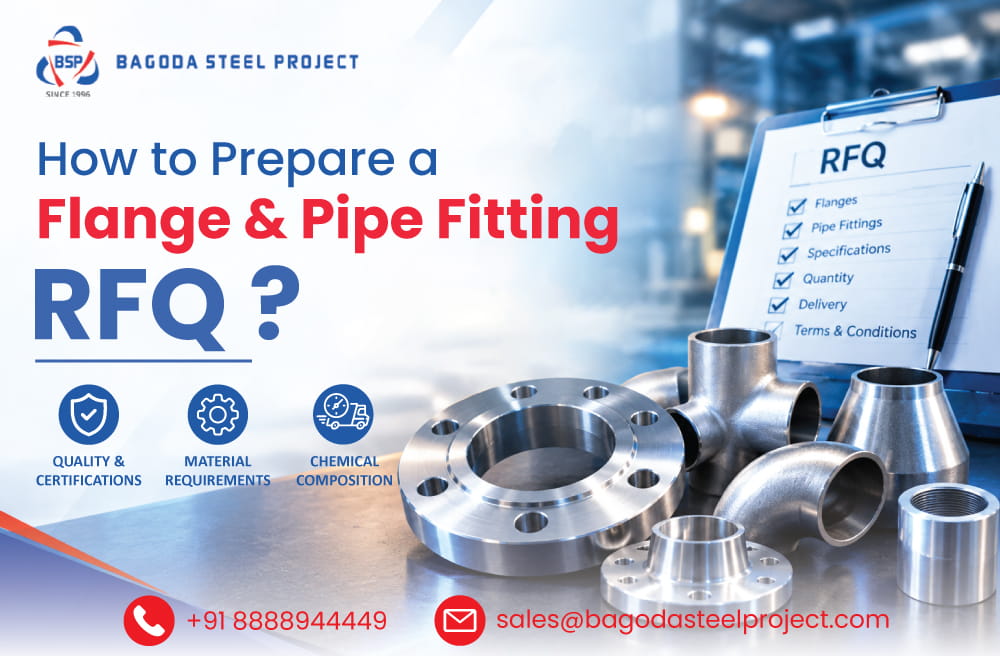
How to Prepare a Flange & Pipe Fitting RFQ: Essential Details to Include?
When purchasing industrial flanges and pipe fittings, a well-prepared flange and pipe fitting RFQ (Request for Quotation) can make the procurement process faster, clearer, and more accurate. An RFQ provides suppliers with the technical, commercial, and delivery information required to quote the correct products and avoid costly misunderstandings.
For industries such as oil and gas, petrochemicals, power generation, chemical processing, water treatment, and engineering projects, even a small difference in flange dimensions, material grade, pressure class, or fitting specification can affect compatibility and performance.
We at Bagoda Steel Project provide you with this guide explaining to you how to prepare a flange and pipe fitting RFQ using the
What Is a Flange & Pipe Fitting RFQ?
A flange and pipe fitting RFQ is a formal document sent to manufacturers, stockists, distributors, or suppliers requesting pricing and supply information for specified piping components.
The RFQ should clearly describe the products required, including:
- Flange type
- Pipe fitting type
- Material grade
- Size and dimensions
- Pressure rating or class
- Schedule or wall thickness
- Applicable standards
- Quantity
- Inspection and testing requirements
- Required documentation
- Delivery location
- Expected delivery date
- Commercial terms
The more complete the RFQ, the easier it is for suppliers to provide technically accurate and comparable quotations.
Why Is a Detailed RFQ Important?
A detailed RFQ reduces ambiguity between the buyer and supplier. Industrial piping components are manufactured according to numerous standards, materials, dimensions, and pressure classifications. Simply asking for "stainless steel flanges" or "butt weld fittings" may not provide enough information for an accurate quotation.
A properly prepared RFQ helps prevent:
- Incorrect material selection
- Wrong flange dimensions
- Incorrect pressure class
- Specification mismatches
- Delays caused by clarification
- Unexpected additional costs
- Non-compliant material supply
It also allows procurement teams to compare quotations on a like-for-like basis.
Who Should Prepare the RFQ?
The RFQ is normally prepared by the procurement or purchase department, with technical information supplied or reviewed by engineering, project, quality, or piping teams.
For critical applications, the technical team should verify the specifications before the RFQ is released.
The RFQ may then be sent to qualified:
- Flange manufacturers
- Pipe fitting manufacturers
- Industrial piping suppliers
- Authorized distributors
- Stockists
- Exporters
The supplier should receive the latest approved drawings, specifications, material requirements, and applicable project standards wherever relevant.
When Should You Issue a Flange & Pipe Fitting RFQ?
An RFQ should be prepared early enough to allow suppliers to review specifications, calculate pricing, check stock or manufacturing capacity, and confirm delivery schedules.
For engineered or customized components, additional time may be required for:
- Technical clarification
- Drawing approval
- Manufacturing
- Inspection
- Testing
- Third-party inspection
- Documentation
- Packing and transportation
For urgent requirements, the RFQ should clearly identify the required delivery date and whether partial shipments are acceptable.
Where Should the RFQ Specify Delivery?
The delivery location is an important commercial detail because freight, insurance, taxes, and logistics can influence the final quotation.
Clearly state:
- Delivery city and country
- Project/site location, where applicable
- Preferred shipping method
- Required delivery date
- Packaging requirements
- Whether transportation is included
- Applicable Incoterms for international purchases
For domestic Indian purchases, buyers should also specify the applicable billing and delivery requirements and GST-related details where necessary.
How Should You Prepare a Flange & Pipe Fitting RFQ?
A good RFQ should be structured so that the supplier can quickly identify exactly what is required.
-
Specify the Flange Type
State the exact flange type instead of using a generic description.
Common flange types include:
- Weld Neck Flanges
- Slip-On Flanges
- Blind Flanges
- Socket Weld Flanges
- Threaded Flanges
- Lap Joint Flanges
Also mention whether the flange is required with a raised face (RF), flat face (FF), ring-type joint (RTJ), or another facing arrangement.
-
Provide Pipe Fitting Details
Identify the exact fittings required, such as:
- Elbows
- Tees
- Reducers
- Caps
- Crosses
- Stub Ends
- Couplings
For elbows, specify parameters such as 45° or 90°, long radius or short radius, where applicable.
For reducers, identify whether a concentric or eccentric reducer is required.
-
Mention Material Grade
Material specification is one of the most important RFQ requirements.
Examples may include:
- Stainless Steel 304/304L
- Stainless Steel 316/316L
- Carbon Steel
- Duplex Stainless Steel
- Alloy Steel
- Nickel Alloys
- Inconel
- Hastelloy
- Monel
Where applicable, provide the relevant ASTM, ASME, EN, or project material specification and grade.
-
Include Size, Schedule & Dimensions
For flanges, include:
- Nominal Pipe Size (NPS)
- Outside diameter
- Bore
- Thickness
- Bolt-hole details
- Bolt circle diameter
- Number of holes
- Flange facing
For fittings, provide:
- Nominal size
- Schedule
- Wall thickness
- End-to-end dimensions
- Outside diameter
- Radius or configuration
A dimensional drawing can be attached when customized or critical components are required.
-
State Pressure Rating
The RFQ should clearly mention the required pressure class or rating.
Examples include:
- Class 150
- Class 300
- Class 600
- Class 900
- Class 1500
- Class 2500
Do not assume that a supplier will select the pressure class based only on pipe size.
-
Mention Applicable Standards
The RFQ should identify the required manufacturing and dimensional standards.
Depending on the product, these may include relevant ASME, ASTM, API, MSS, EN, or project-specific standards.
Clearly stating the applicable standard reduces the possibility of receiving technically different products from different suppliers.
-
Specify Quantity
Provide the exact quantity required for every item.
A useful RFQ table can include:
Item Description Size Material Class/Schedule Standard Quantity 1 Weld Neck Flange 4" ASTM/ASME specified grade Class 300 Applicable standard 20 2 90° Elbow 4" ASTM/ASME specified grade Sch. 40 Applicable standard 15 3 Blind Flange 6" ASTM/ASME specified grade Class 600 Applicable standard -
Include Inspection & Testing Requirements
For project-critical applications, state the required inspection and testing requirements.
These may include:
- Dimensional inspection
- Visual inspection
- PMI (Positive Material Identification)
- Hydrostatic testing, where applicable
- Nondestructive testing
- Hardness testing
- Third-party inspection
Also specify whether inspection certificates or test reports are mandatory.
-
Request Material & Quality Documents
Depending on project requirements, request documents such as:
- Material Test Certificates (MTC)
- Certificate of Conformance
- Inspection reports
- PMI reports
- Test certificates
- Heat treatment records
- NDT reports
- Traceability documentation
- Packing list
Document requirements should be established before ordering rather than after manufacturing.
-
Add Commercial Requirements
Finally, specify what you expect in the quotation:
- Unit price
- Total price
- Taxes
- Freight
- Delivery period
- Payment terms
- Quote validity
- Warranty
- Packaging
- Country of origin
- Inspection charges
- Documentation charges
Ask suppliers to clearly identify exclusions so quotations can be compared accurately.
Conclusion
Preparing a comprehensive flange and pipe fitting RFQ is an important step in industrial piping procurement. The RFQ should answer the fundamental 5 W's and 1 H: What is required, Why is it required, Who will supply it, When is it needed, Where should it be delivered, and How must it be manufactured, inspected, documented, and supplied?
Including product type, material grade, dimensions, size, schedule, pressure class, standards, quantity, testing, documentation, delivery, and commercial requirements gives suppliers the information they need to prepare accurate quotations.
For businesses sourcing industrial flanges and pipe fittings, a technically detailed RFQ can help streamline supplier communication, minimize specification errors, and support more efficient procurement decisions.
Bagoda Steel Project can assist buyers and project teams with industrial piping requirements by focusing on clear specifications, material requirements, dimensional accuracy, and project-specific supply needs.
FAQ
1. What is a flange and pipe fitting RFQ?
A flange and pipe fitting RFQ is a Request for Quotation sent to suppliers to obtain pricing and supply details for specified flanges and pipe fittings. It normally includes product type, size, material, dimensions, pressure rating, standards, quantity, inspection requirements, and delivery details.
2. What details should be included in a flange RFQ?
A flange RFQ should include flange type, nominal size, material grade, pressure class, facing type, dimensions, applicable manufacturing standards, quantity, inspection requirements, documentation, delivery location, and required delivery date.
3. What information is required for a pipe fitting RFQ?
A pipe fitting RFQ should specify the fitting type, nominal size, schedule or wall thickness, material grade, configuration, applicable standards, quantity, testing requirements, documentation, and delivery requirements.
4. Why are material grade and pressure class important in an RFQ?
Material grade determines the required material specification and suitability for the intended service, while pressure class identifies the required pressure-temperature rating of the flange. Providing both helps suppliers quote the correct component.
5. How can I make a flange and pipe fitting RFQ more accurate?
Use an itemized RFQ containing product descriptions, sizes, materials, schedules, pressure classes, standards, quantities, drawings where necessary, inspection requirements, documentation requirements, delivery details, and commercial terms. For complex projects, have the RFQ reviewed by the engineering and quality teams before sending it to suppliers.
